
Picture this: it's 7 p.m., your ten-week-old puppy has hit that wild-eyed hour, and every time you reach for her she latches onto your sleeve, your fingers, the hem of your jeans. Those needle teeth actually hurt, and by day four you're wondering if you adopted a puppy or a tiny land shark.
Here's the good news, and I mean it. Biting and nipping are completely normal puppy behavior. It is not aggression, it is not a sign you got a "bad" dog, and it is one of the most fixable things I work on as a trainer.
What follows is the exact approach I walk new owners through. It's force-free, and it works because it teaches your puppy what to do instead of just yelling about what not to do.
Why Puppies Bite in the First Place
Puppies explore the world with their mouths the way human babies grab everything in reach. Mouthing is how they investigate texture, temperature, and whether that thing is food.
On top of that, they're teething. Somewhere between roughly three and six months, those baby teeth loosen and adult teeth push through, and chewing on things (including you) feels good on sore gums.
And then there's play. In a litter, puppies wrestle and bite each other constantly. When one bites too hard, the other yelps and play stops. That feedback loop is how they learn to control their jaws, and it's the exact lesson we're going to recreate.
Your puppy isn't being "bad" or dominant. She's doing textbook puppy stuff. Once you see nipping as a communication and teething behavior, the fix stops feeling like a battle and starts feeling like teaching.
Teach Bite Inhibition First
Before we stop the biting entirely, we teach your puppy to be gentle with her mouth. This is called bite inhibition, and it's genuinely one of the most important things a young dog can learn.
Here's the method. When your puppy bites too hard during play, let out a calm, clear "ouch" and freeze. Stop moving your hand, stop the fun, and go still for a few seconds.
Most puppies pause, a little surprised. That pause is your window. The moment she softens or lets go, calmly praise her and continue playing. You're telling her, in a language she already understands from the litter, that soft mouths keep the game going and hard bites end it.
Keep your reaction low-key. Shrieking or yanking your hand away fast can actually rev some puppies up more, because a flailing hand looks like a fun toy. Slow and boring is the goal.
Redirect Onto Something She's Allowed to Bite
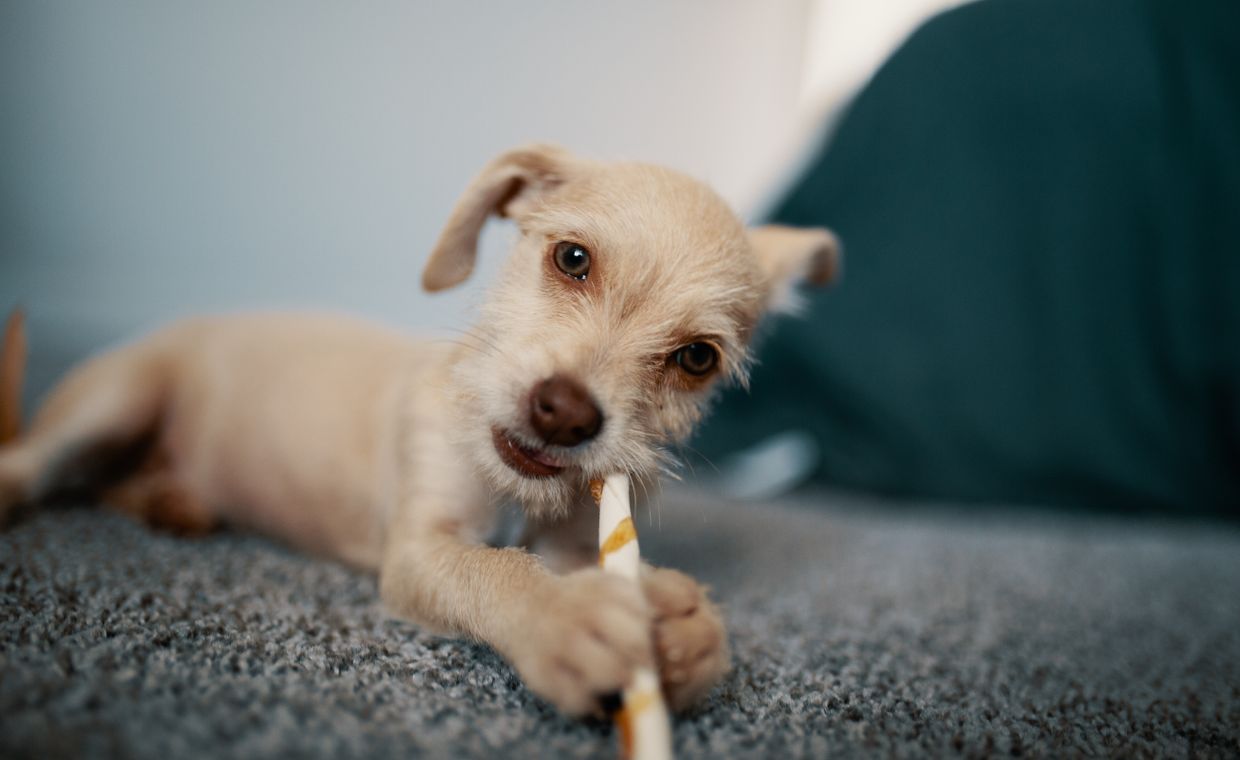
A puppy who wants to bite needs a legal target. This is the single most practical habit you can build, so keep chew toys within arm's reach in every room you spend time in.
The instant those teeth head for your hand, calmly offer a toy instead. When she takes it, praise her warmly. You're not punishing the bite, you're rerouting it to the right object.
Rotate a few textures so she stays interested: a rubber chew, a rope toy, something you can freeze for teething relief. A cold, damp washcloth twisted and frozen works wonders on sore gums, and it costs nothing.
What to Do When Redirection Isn't Enough
Sometimes your puppy is too wound up to take a toy. She's in full zoomie mode and your hand is the most exciting thing in the universe. This is where the "time-out" comes in.
A force-free time-out is not scary. You simply end the fun. Stand up, step over a baby gate or behind a door for 20 to 30 seconds, and give the excitement a moment to drain out of her system.
The lesson lands because of timing, not intensity. Bite hard, the human becomes boring and leaves. Stay gentle, the human stays and plays. Short and consistent beats long and dramatic every single time.
Manage the Triggers Behind the Nipping
A huge amount of "bad" biting is really an overtired puppy who doesn't know how to settle. Puppies need a shocking amount of sleep, often 16 to 18 hours a day, and the crankiest nipping usually shows up when they're overdue for a nap.
If your puppy turns into a piranha every evening, try enforcing quiet rest before she melts down. A calm crate routine helps enormously here, and if you're not sure how to make the crate a happy place, my guide on how to crate train a puppy without stress walks through it step by step.
Watch the other triggers too. Rough hand-play, wiggling fingers, and games that use your body as the toy all teach a puppy that skin is fair game. Swap those for tug and fetch, where a toy always sits between your hand and her teeth.
| Situation | Do this | Skip this |
|---|---|---|
| Gentle mouthing during play | Keep playing, reward soft mouth | Punishing every touch of teeth |
| Bite that actually hurts | Calm "ouch," freeze, then redirect | Yanking hand away fast |
| Overtired, frantic nipping | Guide to a nap or crate | More stimulation or wrestling |
| Teething discomfort | Offer a frozen chew toy | Letting her chew hands |
| Full zoomie meltdown | Brief 20-30 second time-out | Yelling or physical corrections |
Build the Right Habits With Rewards
Every time your puppy chooses a toy over your hand, or settles instead of nipping, you have a chance to mark that choice and reward it. That's how you grow the behavior you actually want.
Reward calm. When she's lying quietly with a chew, drop a bit of praise or a small treat her way so she learns that settled and gentle earns good things. If you're newer to reward-based training, start with my positive reinforcement basics for owners so the timing clicks.
Consistency across the household matters more than any single technique. If one person allows hand-wrestling while everyone else redirects, your puppy gets a mixed message and progress stalls. A lot of these mixed signals show up in my roundup of common training mistakes that confuse your dog and how to fix them, and puppy biting is where they bite hardest, pun intended.
How Long Until It Actually Stops
Let's set honest expectations, because "for good" doesn't mean overnight. Most puppies show real improvement within two to four weeks of consistent work, and the sharpest nipping usually fades as the adult teeth finish coming in around six to seven months.
You'll see progress in stages. First the bites get softer, then they get less frequent, then your puppy starts reaching for a toy on her own instead of your hand. Celebrate those small wins, because they're the whole game.
If the biting is intense, seems fearful rather than playful, or isn't budging at all despite consistent effort, loop in a qualified force-free trainer or your vet to rule out pain or another underlying cause. General guidance like this covers the vast majority of normal puppies, but a stubborn or worrying pattern deserves real eyes on it.
Is it too late to stop biting if my puppy is already six months old?
Not at all. The same steps work, they may just take a little longer since the habit is more practiced. Stay consistent with redirection and rewards, and if an older puppy is biting hard or seems anxious, check in with a trainer or vet.
Should I yelp loudly like another puppy would?
A calm, low "ouch" works better than a loud shriek. High-pitched yelping excites some puppies and makes them bite more. Keep your reaction quiet and boring, then redirect to a toy.
My puppy only bites me, not my partner. Why?
Usually it's about how each person interacts. Whoever moves their hands fast, wrestles, or reacts dramatically becomes the fun target. Match your responses across the household and the biting tends to even out.
Puppy biting feels endless when you're in the thick of it, but it really is a phase you get to shape. Keep your toys handy, your reactions calm, and your rewards flowing, and you'll be amazed how fast those needle teeth turn into a gentle mouth. You've got this, and your future dog will thank you for putting in the work now.