
I spend most of my days reading cats, but I live with a dog too, and the thing that fascinates me is how patiently he tries to make sense of us. He watches our hands, our faces, the second our weight shifts toward the door. Dogs are constantly translating, and when training stalls, it is rarely because the dog is stubborn. It is usually because the message keeps changing.
From a quieter, observational seat, the pattern becomes obvious. We say one thing on Monday and the opposite on Thursday. We reward late. We repeat a word until it loses all meaning. None of it is unkind, but to a dog it feels like static on the radio.
Here are seven mistakes I see again and again, why each one confuses your dog, and the small fix that brings the signal back into focus.
1. Using a different word every time you mean the same thing
One morning it is "off," by lunch it is "down," and by evening someone yells "get off the couch" while clapping. To you these all mean the same thing. To your dog they are three unrelated sounds attached to one mystery.
Why it matters: Dogs do not generalize language the way we do. Each new phrase is a brand-new puzzle, so progress that looked solid suddenly evaporates because the cue itself moved.
The fix: Pick one word per behavior and write the list on the fridge so the whole household agrees. "Off" means paws on the floor. "Down" means lie flat. Keep them separate, say each once, and let the consistency do the heavy lifting.
2. Rewarding several seconds too late
Your dog sits, you reach for the treat pouch, fumble the zipper, and by the time the food arrives your dog has stood back up and is sniffing your shoe. You meant to reward the sit. You actually rewarded the sniff.
Why it matters: Timing is the whole conversation. A reward marks the exact instant a behavior happened, and a dog's "exact instant" is roughly one second wide. Late treats teach the wrong moment.
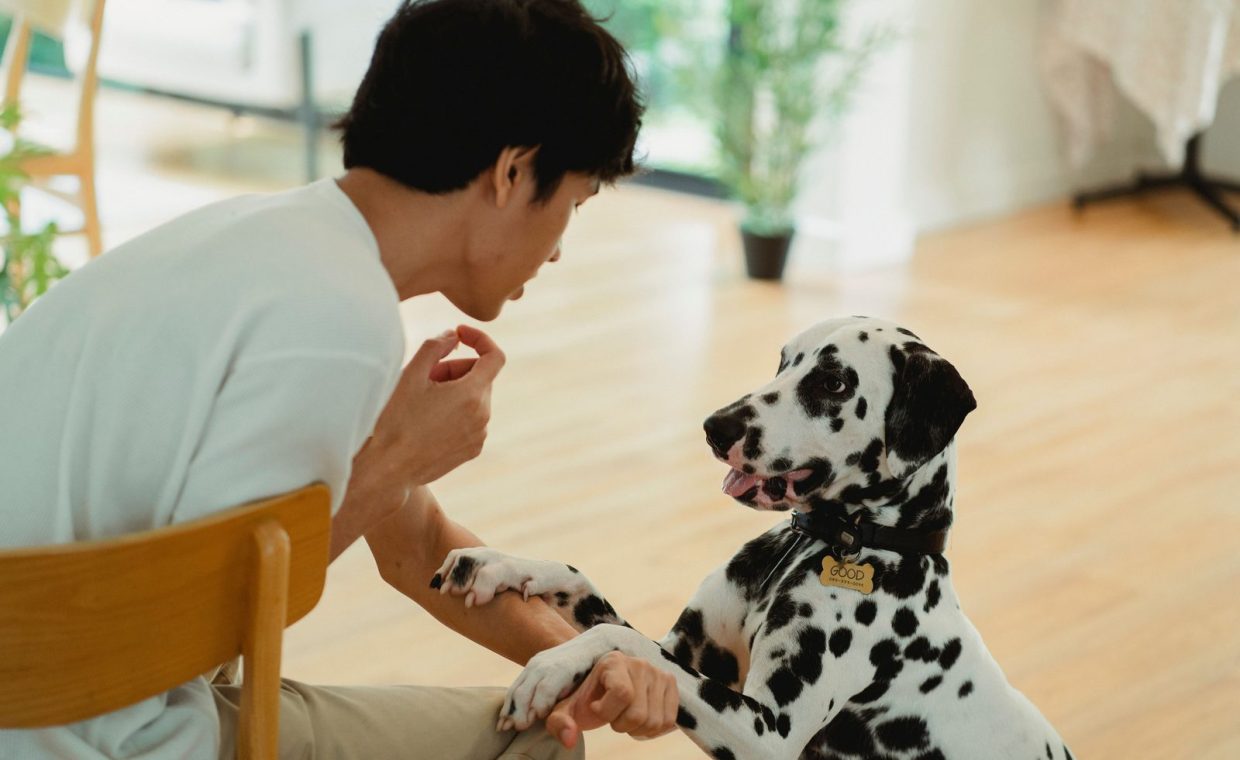
Use a short word like "yes" or a clicker the moment your dog does the right thing, then deliver the treat a beat later. The marker freezes the correct moment so your slower hands can catch up without muddying the lesson.
3. Repeating a cue until it means nothing
"Sit. Sit. Sit-sit-sit. SIT." I hear this in every park. The dog eventually sits, and the human feels successful, but something quiet just broke.
Why it matters: Your dog learns that the cue is actually the whole chant, not the single word. Worse, they learn they can ignore the first four requests because a fifth is always coming. You have trained patience out of yourself and stalling into them.
The fix: Say the word once. If nothing happens, wait, help the dog into position, or make the moment easier, then ask again later. One cue, one chance, then you adjust the setup rather than your volume.
4. Practicing only in the calm of your living room
Your dog is flawless at home and a stranger to their own name the moment you reach the sidewalk. People take this personally. It is not defiance, it is geography.
Why it matters: Dogs attach learning to context far more tightly than we expect. A behavior rehearsed only in the kitchen lives in the kitchen. The front yard, the vet lobby, the bustling trail are all separate classrooms.
The fix: Reteach each skill in small new places, starting easy and adding distraction slowly. This is exactly the patience that carried us through our three-week project to fix a rescue dog's leash pulling, where the quiet hallway came before the busy street, never the other way around.
5. Accidentally rewarding the very thing you dislike
Your dog jumps up, you push them off and say "no," and they jump again, delighted. The shove was contact. The eye contact was attention. To a social animal, that is a jackpot.
Why it matters: Attention is currency, and dogs do not separate the good kind from the scolding kind nearly as cleanly as we do. Behaviors that earn a reaction tend to grow, even when the reaction is a frustrated one.
Decide what you want instead of what you want to stop. Reward four paws on the floor, a settled mat, a soft glance back at you. When the calm choice pays better than the pushy one, your dog will quietly start choosing it.
6. Mixing up house training with general "being bad"
A puddle appears by the door, and a tired owner sighs that the dog "knows better." Often the dog knows almost nothing yet, because the routine was never built clearly in the first place.
Why it matters: Punishing accidents after the fact teaches a dog to hide from you, not to hold it. The fear of your reaction can make them slink off to eliminate where you cannot see, which feels like spite but is really confusion.
The fix: Go back to a predictable schedule, frequent trips outside, and generous praise for getting it right, the calm approach we walk through in our reliable method for house training a puppy. Clean accidents without drama and tighten supervision rather than tightening your voice.
7. Asking for too much before your dog feels safe
This is the one I notice most, maybe because cats taught me to watch for it. A newly adopted dog gets enrolled in lessons on day two, and everyone wonders why nothing sticks. The dog is not failing. The dog is still scanning the room for exits.
Why it matters: A nervous nervous system cannot learn well. When a dog is busy deciding whether they are safe, there is little attention left for "stay." Pushing through that state teaches stress, not skills.
The fix: Let security come first and training second. Decompression, predictable routines, and gentle wins are what helped our shy rescue dog settle in over thirty days before we asked anything ambitious of him. A relaxed dog is a dog who can hear you.
Almost every confused dog is responding to a moving target: shifting words, slippery timing, lessons that only exist in one room. Hold the signal steady and clarity returns faster than you would expect.
When to look past training
Sometimes a sudden change is not a training gap at all. A dog who was reliably house trained and abruptly starts having accidents, or one who becomes withdrawn or unusually reactive, may be telling you something physical.
If the shift is sudden or paired with signs like vomiting, lethargy, or pain, talk to your own veterinarian rather than drilling cues. And for anything frightening, such as trouble breathing, collapse, seizures, a suspected poisoning, or a swollen, distended belly, treat it as an emergency and contact a vet or emergency clinic right away.
How long does it take to fix a confused cue?
Often faster than people fear. Once the word, the timing, and the reward all line up consistently, many dogs show clearer responses within a week or two. Older confusion can take longer, but the direction usually changes quickly.
Will I always need treats to get the behavior?
No. Food is a teaching tool, not a permanent paycheck. As a behavior becomes reliable you reward less predictably and lean more on praise, play, and life rewards like going through a door. The behavior stays; the treats fade.
My whole family trains the dog differently. Does that matter?
It matters a great deal. Different words and rules from each person are one of the biggest sources of confusion. A short shared list of cues and house rules, agreed on by everyone, usually helps more than any single technique.
If you take one thing from all of this, let it be patience with the translation work your dog is already doing. They are trying to understand you every single day. Steady your signals, slow down, and ask your vet whenever a change feels physical rather than behavioral. The clarity you offer comes straight back to you.