
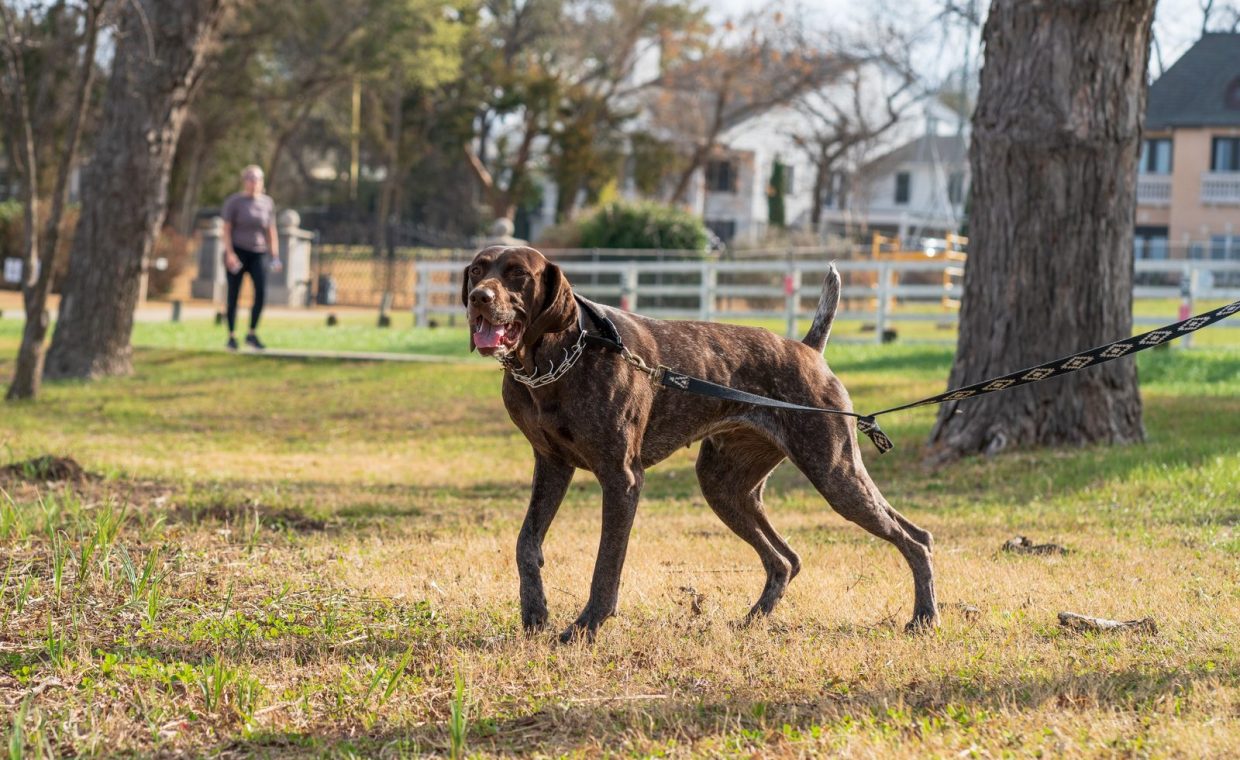
The first walk with Juno lasted about four minutes before my shoulder gave the verdict. She was a 50-pound shepherd-something mix, eight months out of a county shelter, and she walked like the sidewalk was on fire and she alone could put it out. Front legs digging, head down, that telltale wheeze of a dog choking herself against her own collar.
Her foster mom had warned me. "She pulls." What she meant was that Juno didn't walk you so much as tow you, like a tugboat that had recently discovered espresso. I'm a trainer, and I still ended up catching my breath on a neighbor's wall, wondering what I'd signed up for.
Three weeks later we walked a full block past a barking terrier with the leash hanging in a loose J between us. No miracle, no special collar, no shouting. Just a plan, a pouch of chicken, and a refusal to make it a fight. Here's how it went.
Why Juno pulled in the first place
Pulling isn't disobedience. It's the most natural thing in the world for a dog. They walk faster than we do, the world is a buffet of smells, and every time a tight leash gets them one step closer to the lamppost, the pull gets rewarded. Tension on the leash had become Juno's normal.
Rescue dogs add another layer. Juno had spent months in a kennel with almost no structured movement, so a real walk was pure sensory overload. She wasn't being stubborn. She was a teenager who'd never been to a city, suddenly dropped into one.
I stopped thinking of the walk as a battle to win and started thinking of it as a conversation. My job wasn't to stop her from pulling. It was to make staying near me the most rewarding option on the street.
Week one: rebuilding the foundation indoors
We barely left the driveway the first week, and that surprised everyone who met us. Before you can fix a leash, the dog has to believe that being next to you pays. So we played the simplest game there is: I'd mark the moment Juno glanced at me, then drop a piece of chicken by my left heel.
Glance, mark, treat. Over and over, in the kitchen, the hallway, the backyard. Within two days she was checking in with me constantly, because checking in had become the thing that made food appear. That habit is the whole foundation, and it's the same one I lean on for almost everything, including the kind of quick crowd-pleasing tricks you can teach over a weekend.
I also made sure her tank was empty before each session. A dog with pent-up energy can't think, and Juno had plenty. We'll come back to that.
Week two: the "tree" and the U-turn
Now we hit the sidewalk, and I introduced two boring, undramatic tools that did all the heavy lifting.
Becoming a tree
The first was simple: the second the leash went tight, I stopped. Dead stop. Feet planted, no scolding, no yank. Juno would hit the end of the leash, get confused that the parade had ended, and eventually turn back to look at me. The instant the leash softened, I marked it and we moved on. Tight leash means the world freezes. Loose leash means we go.
The surprise U-turn
The second tool was the U-turn. When Juno locked onto something across the street and I could feel the lunge building, I'd cheerfully say "this way," turn, and walk the other direction. She learned that fixating on a target didn't get her there, but staying loose and connected to me did.
Use a 6-foot fixed leash for this, not a retractable one. A retractable leash teaches a dog that constant tension is normal, which is the exact opposite of what you want.
The gear that helped (and what I skipped)
People always want the magic harness. But gear manages pulling, it doesn't teach loose-leash walking. The right equipment just buys you breathing room while the training catches up.
| Option | What it did for us | My honest take |
|---|---|---|
| Front-clip harness | Redirected Juno's momentum sideways instead of forward when she lunged | The single most useful piece of gear. Took pressure off her throat and my arm. |
| Flat collar | Held her ID and tags | Fine for ID, but I never walked her on it. Throat pressure makes pulling worse. |
| Treat pouch | Kept rewards instant and one-handed | Unglamorous and essential. Fumbling for a treat kills your timing. |
| Prong / choke collar | Not used | Skipped entirely. They punish the pull but can raise fear and reactivity, especially in a rescue still learning to trust. |
A front-clip harness gives you mechanical help without pain. If you've already done the patient relationship-building that goes into something like house training a dog the reliable way, you'll recognize the pattern here: reward the behavior you want, manage the environment, and let the dog succeed often.
The piece everyone forgets: exercise comes first
Here's the mistake I watched a dozen owners make at the shelter, and one I almost made myself. They'd take an under-exercised dog straight into a precision leash lesson and wonder why it fell apart in ninety seconds.
A dog vibrating with unspent energy cannot learn. Before our week-two training walks, Juno got a long-line romp in a quiet field or a hard game of fetch in the yard. Drained dogs are thoughtful dogs. If you're unsure how much your dog actually needs, it's worth reading up on how much daily exercise your dog really needs, because the answer for a young shepherd mix is "more than you think."
Sudden, dramatic pulling or a dog that gasps, coughs hard, or seems to choke on a collar can point to a throat or airway issue. If your dog struggles to breathe, collapses, or you suspect anything is medically wrong, contact your veterinarian or an emergency clinic right away rather than pushing through training.
Week three: putting it all together on a real walk
By the third week the pieces clicked into one fluid thing. We'd warm up with a quick check-in game on the porch, then head out. When Juno drifted ahead, I'd become a tree. When she checked in, chicken rained from the sky. The walks got longer and the treats got rarer, because the loose leash was becoming its own reward.
The terrier test came on a Thursday. That yappy little dog had been Juno's nemesis for a month. This time she tensed, glanced up at me, and chose to keep walking. I marked it, jackpotted her with three treats in a row, and may have whooped loud enough to embarrass us both. That's the moment you train for.
She wasn't a finished dog. She still had bad days, and so did I. But the default had flipped from pulling to walking, and once that switch trips, everything gets easier.
Build value for staying near you indoors first. On the sidewalk, freeze on a tight leash and reward a loose one. Use a front-clip harness, never throat pressure. Exercise the dog before you train. And reward generously early, then fade the food as the habit sets. Three weeks of short, consistent sessions beat one heroic hour.
How long does it really take to fix leash pulling?
For us it was about three weeks of short daily sessions to flip the default, but every dog is different. Older habits, high-distraction neighborhoods, and rescue backgrounds can stretch that timeline. Consistency matters far more than speed.
Are no-pull harnesses or special collars enough on their own?
A front-clip harness genuinely helps by redirecting momentum, but it manages pulling rather than teaching loose-leash walking. The training is what creates the lasting change. I'd skip prong and choke collars, which can increase fear and reactivity, especially in a dog still learning to trust people.
What if my dog is too excited to take treats outside?
That usually means the environment is too hard or your dog has too much unspent energy. Exercise first, start training in a calm spot like your driveway, and use higher-value food such as chicken or cheese. If your dog never eats on walks or seems unwell, check in with your veterinarian.
Juno's a couch professional now, and our walks are the easy part of the day. If your dog is towing you down the block, you're not failing and your dog isn't broken. Pick one quiet stretch of sidewalk, bring better treats than you think you need, and reward the small wins. The loose leash will follow.