
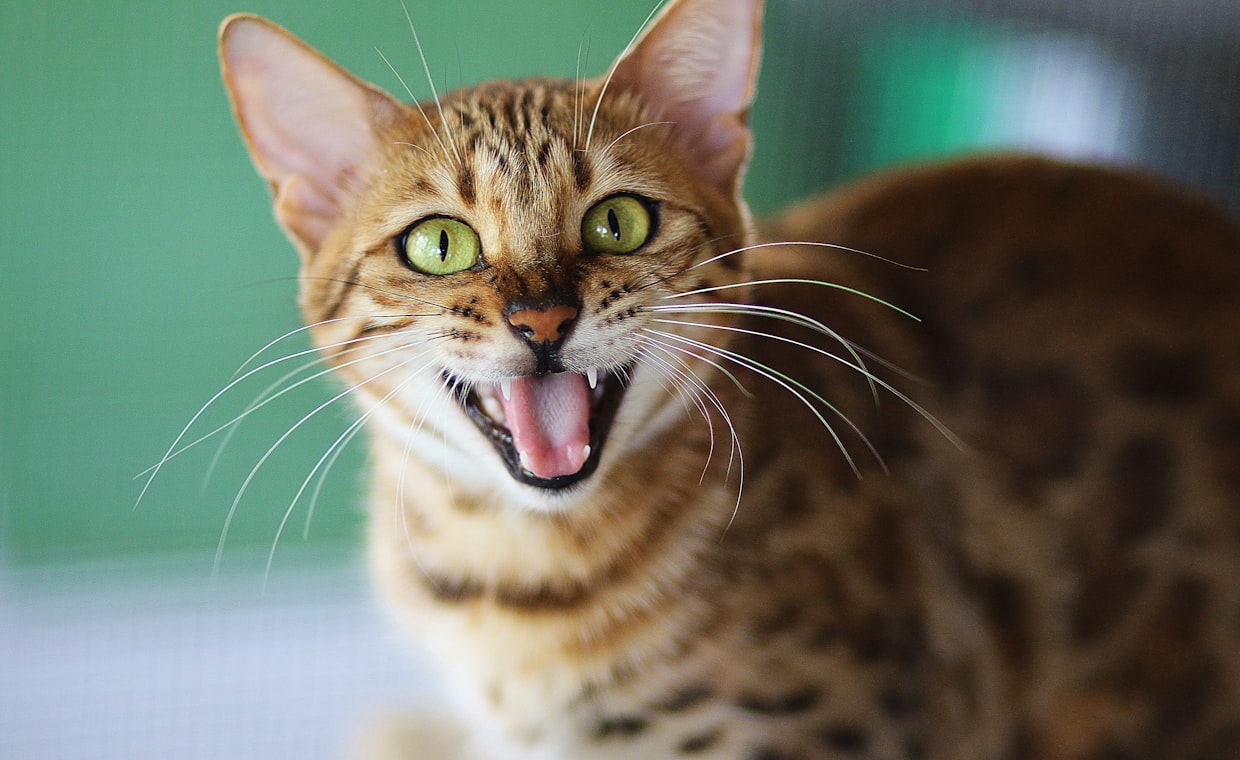
At 5:47 a.m. my client's tabby, Pancake, plants himself outside the bedroom door and delivers roughly forty short meows in a row, one every couple of seconds, until someone stumbles out to fill his bowl. His owner swore he was "just being dramatic." He was, a little. He was also doing something clever that most people miss.
Here is the part that surprises folks: adult cats barely meow at each other. Kittens meow to their mothers, then mostly stop. The chatty adult cat in your living room developed that habit for one audience, and that audience is you.
So when your cat seems to talk nonstop, it is rarely random noise. It is a request, a report, or a running commentary aimed squarely at the human who feeds and pets them. Learning to read it turns a nagging soundtrack into a conversation you can actually answer.
Meowing Is a Human Language First
Cats have a huge vocal range, but the classic "meow" is something they largely reserve for people. Between cats you will hear hisses, growls, chirps, and yowls, yet the polite little "mew" is aimed at us because, over thousands of years, it worked. We respond to it.
Each cat also builds a private dialect with their own household. Pancake's rapid-fire breakfast chant means one thing in his home. Your cat's single drawn-out "mrrraow" at the closet might mean the treat bag lives in there. There is no universal dictionary, only the one you two write together.
The Usual Suspects Behind Constant Meowing
Most heavy meowing traces back to a short list of needs. Work through these before you assume your cat is simply loud by nature.
- Hunger or a schedule shift. The alarm-clock meow is the most common one I see, especially around dawn or your usual feeding time.
- Attention and play. A bored cat will absolutely narrate their boredom at you until something interesting happens.
- Greetings. Some cats announce every entrance and exit. That chirpy hello when you walk in is affection, plain and simple.
- Access. Closed doors, empty water bowls, and a litter box that needs scooping all generate very pointed complaints.
- Stress or change. New furniture, a houseguest, or a moved feeding station can crank up the volume.
A cat who suddenly gets louder, though, is telling you something changed. Sudden is the word I want you to underline.
Reading the Meow: Pitch, Length, and Body
The sound carries half the message. The body carries the rest. A high, short, bright meow usually reads as friendly or hopeful. A low, long, insistent one leans toward demand or discomfort.
Watch the whole cat while they vocalize. Tail up with a little hook at the tip, soft eyes, ears forward: that is a happy request. Flattened ears, a lashing tail, a crouched body, or dilated pupils shifts the meaning toward fear, irritation, or pain, and that deserves closer attention.
Body language and voice work together, and the more fluent you get in both, the fewer 5 a.m. mysteries you will have. If you want to go deeper on the quieter cues, the signs your cat trusts you often show up in the same relaxed posture that accompanies a friendly, chatty greeting.
| Meow style | What it often means | Your best response |
|---|---|---|
| Short, high, repeated | Greeting or "notice me" | Acknowledge, brief pet or play |
| Long, drawn-out "mrrraow" | A specific demand (food, door, toy) | Follow the cat and check the target |
| Low, insistent, near a spot | Access blocked (bowl, box, room) | Refill, scoop, or open up |
| Loud yowl, worried body | Distress, pain, or disorientation | Check the cat, call your vet if it persists |
| Night-time roaming meows | Boredom, hunting energy, or aging | More daytime play, vet check if new |
The 3 a.m. Concert
Nighttime meowing has its own flavor. Cats are crepuscular, meaning they wake up wanting to hunt around dawn and dusk, and a well-rested indoor cat has energy to burn at exactly the hours you want to sleep.
Sometimes that energy shows up as gifts instead of noise, which is its own funny puzzle. If your cat hauls a mouse toy to your pillow at midnight, the reasons behind why cat brings toys night overlap heavily with why they serenade you: leftover hunting drive with no daytime outlet.
The fix is usually boredom management, not scolding. A structured play session before bed, ending with a small meal, mimics the natural hunt-eat-groom-sleep cycle and can quiet a surprising number of dawn concerts.
If you feed or open the door the second your cat meows, you have taught them that meowing works. Wait for a pause, even two seconds of quiet, then respond. You are rewarding calm instead of the racket.
When a Meow Is a Medical Message
This is the part where I stop being playful. A real change in your cat's voice is one of the clearest early warnings we get, and it should never be ignored.
Older cats especially can develop hyperthyroidism, high blood pressure, or cognitive decline, all of which can trigger loud, confused, or nighttime yowling. Pain, urinary trouble, and vision loss can do the same at any age.
Turning Down the Volume, Kindly
Once you have ruled out medical causes and mapped the pattern, most excess meowing responds to enrichment and consistency. A cat with a full, interesting day simply has less to complain about.
Feed on a predictable schedule, ideally with a timed feeder for that dawn demand. Add short play sessions, window perches, puzzle feeders, and rotating toys so the hours you are gone stay stimulating. A steady routine to enrich indoor cat day does more for chronic meowing than any quick trick, because it fixes the cause instead of the symptom.
The short version: meowing is your cat talking to you, not at you. Log the patterns, read the body along with the sound, answer real needs, avoid rewarding pure noise, and treat any sudden change as a health question first. Enrichment and routine handle most of the rest.
Give it a couple of weeks of honest observation. You will be startled how much your cat has been saying all along, and how much quieter your mornings get once you actually listen.
Is it bad if my cat meows a lot?
Not necessarily. Some cats and some breeds, like Siamese, are naturally chatty, and that is just their personality. What matters is change. A cat who has always been talkative is different from one who suddenly gets louder, and the sudden shift is the one worth a vet check.
Should I ignore my cat when they meow?
Ignore the demand, not the cat. If you respond the instant they meow, you reinforce the noise, so wait for a brief pause before you act. Do meet real needs like food, water, and a clean box promptly, and add play so boredom meowing has somewhere else to go.
Why does my cat meow at night?
Cats are wired to be active at dawn and dusk, so a well-rested indoor cat often wants to hunt while you sleep. A play session and small meal before bed help a lot. In older cats, new nighttime yowling can signal a health issue and deserves a vet visit.
Pancake, for the record, now gets a timed breakfast at 5:45 and a big play session at night, and the dawn concert has mostly ended. Your cat is not trying to drive you up the wall. They are handing you a puzzle with a solution, and once you learn their particular dialect, you become the person who finally understands. That is a pretty good title to earn.